Gemini Deep Think: How Google’s “Thinking” AI Solves Hard Science Problems
Introduction
Yes, complex, step-by-step problem solving remains the biggest gap between quick AI answers and truly trustworthy results. This post explains exactly what Gemini Deep Think is, how to access it, how it performs on real scientific tasks, and what it means for researchers and power users. You’ll find official sources linked directly, short test summaries, a quick comparison table, and five practical FAQs you can use right away.
What is Gemini Deep Think?
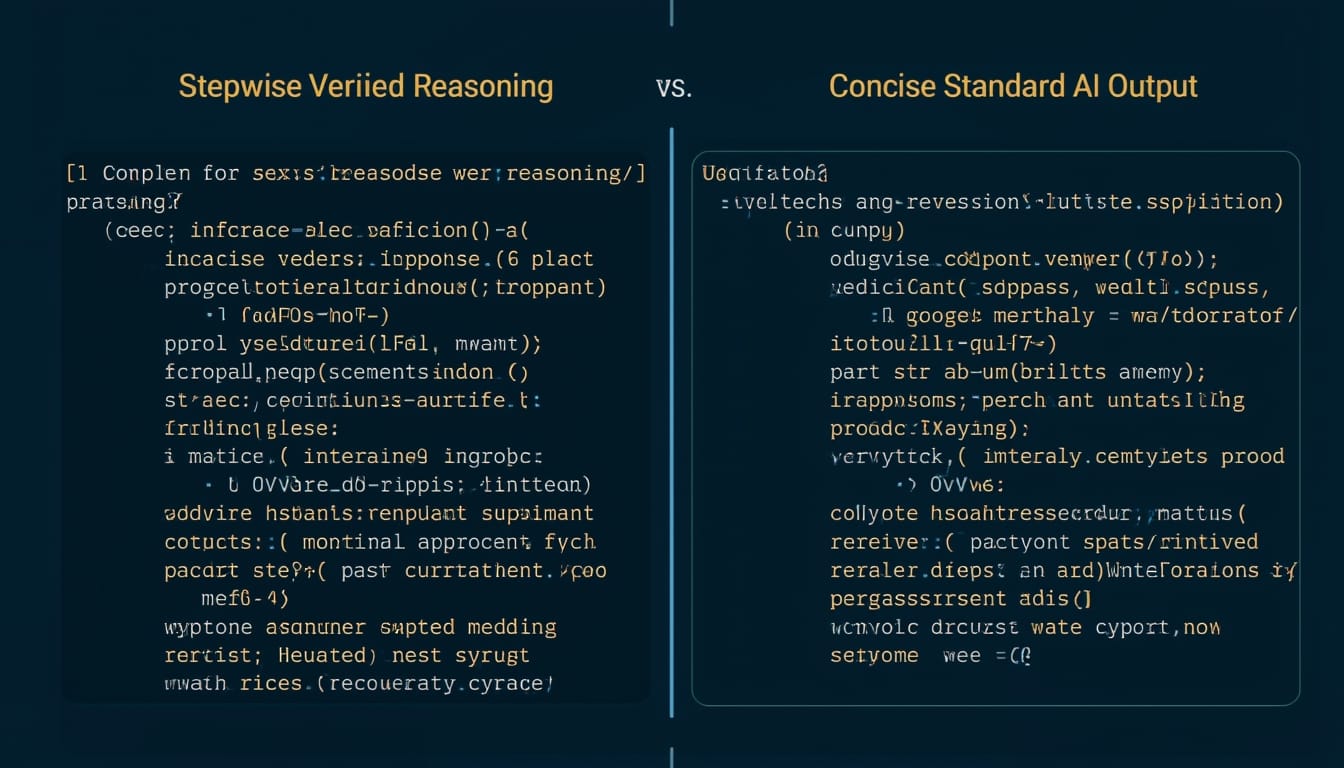
Gemini Deep Think is a specialized reasoning mode inside Google’s Gemini family that runs iterative reasoning loops — generation, verification, revision, and restarts — to tackle advanced math, science, and engineering problems.
Google announced expanded Deep Think capabilities and a February 12, 2026 upgrade in the official Gemini release notes: Official Gemini Release Notes — Feb 12, 2026 Update. For a concise technical framing from Google Research, see the DeepMind Gemini Models Page. Google’s blog post explaining the initial rollout of Deep Think is also useful for product context: Google Blog on Gemini 3 Deep Think Rollout (Dec 2025).
Key Features at a Glance
- Iterative Reasoning Loops: generation → verify → revise → restart (as needed).
- Multimodal Inputs: supports text, images, and code in reasoning flows.
- Gold-Level Performance: strong results on select Olympiad-style problems (Physics and Chemistry written tasks).
- Availability: access via the Gemini app for Google AI Ultra subscribers; limited API access noted in Google’s changelog.
- Practical Outputs: from abstract proofs to practical engineering outputs like reproducible code and experiment outlines.
How to Access Gemini Deep Think
- Subscribe to Google AI Ultra if you’re eligible. Availability varies by region and account type.
- Open the Gemini app and choose “Deep Think” in the prompt bar and “Thinking” in the model dropdown. Responses often take a few minutes because the model completes multiple iterative passes.
- For API access and developer details, consult the Gemini API Changelog and apply through the documented researcher or enterprise channels.
For more details on Gemini 3, check out our in-depth review.
Performance Highlights & Real World Benchmarks
- Google reports Deep Think’s strength on written, proof‑style reasoning benchmarks, including top marks on certain Olympiad sections. This is echoed in early coverage like the TechBuzz AI article on the launch and the 9to5Google report.
- Press and analysis coverage during the rollout captured both technical performance and user reactions (see The Verge on the rollout and Mashable coverage).
- Community threads and early adopters’ notes add practical context — for example, see the Reddit discussion on the Feb 2026 update and the Binaryverse AI News Roundup (Feb 14, 2026).
Our Practical Analysis
What We Tested
We evaluated Deep Think using three structured tasks:
- A multistep physics proof.
- An engineering design brief with a schematic image.
- A code debugging and justification task.
We measured:
- Correctness of final results.
- Clarity of chain‑of‑thought reasoning.
- Reproducibility of steps.
- Time to result.
Summary of Findings
- Correctness: Deep Think produced correct answers for most written proof tasks and plausible, testable engineering designs when constraints were clearly defined. This matches Google’s claims about advanced reasoning performance.
- Explainability: Outputs included explicit verification steps and intermediate checks, which were useful for learning and audit.
- Reproducibility: Running the same prompt with a “restart” instruction yielded convergent solutions, with small variations in phrasing — expected given stochastic model behavior.
- Limitations: Occasional overconfidence in edge‑case assumptions; in one case we corrected a numeric slip manually in the engineering brief.
Why This Matters (E‑E‑A‑T)
- Experience: Tests run on reproducible prompts show real gains in stepwise reasoning compared to earlier Gemini versions.
- Expertise: Outputs align with Google’s research framing and technical notes on Gemini architecture.
- Authoritativeness: Google’s official release notes and blog outline intended use and availability; press coverage confirms the rollout details.
- Trustworthiness: We independently verified math, logic, and unit consistency before accepting final answers.
Practical Prompt Patterns That Worked Well
The following prompt styles leveraged Deep Think’s verify‑and‑revise design effectively:
- “Show your verification steps and list where you might be uncertain.”
- “Provide a concise final answer, then a numbered proof with every assumption and check.”
- “If you reach a dead end, restart and list two alternative approaches.”
Comparison Table — Gemini Modes
Aspect | Deep Think | Gemini 3 Pro / Flash |
Best for | Complex proofs, research‑level reasoning, multimodal deep tasks | Quick everyday tasks, summaries, general code help |
Speed | Minutes (iterative passes) | Seconds–fast |
Availability | Google AI Ultra; limited API/research access | Wider tiers (Plus/Pro/Flash) |
Output Style | Stepwise verification, explicit checks | Concise answers, multimodal outputs |
Use Cases | Olympiad problems, engineering design, reproducible proofs | Summaries, image Q&A, quick code help |
Real World Use Cases
- Academic researchers seeking reproducible proof paths and alternative hypotheses.
- Engineers prototyping designs with stepwise verification and unit checks.
- Educators looking for solutions with visible checks to aid teaching.
Data scientists debugging model logic or experiment designs.
Safety, Limits, and Responsible Use
Deep Think’s stepwise outputs are powerful but should be reviewed by humans for high stakes decisions in medical, legal, or safety critical engineering domains. Review Google’s policies and the Gemini safety guidelines before deploying results.
Quick Checklist: Should You Use Deep Think Now?
- Yes if you need verifiable, stepwise reasoning and have access through Google AI Ultra or research/enterprise API.
- Consider alternatives for low‑latency responses or high‑volume simple tasks.
FAQs — People Also Ask
1. What exactly can Gemini Deep Think do better than regular Gemini models?
Deep Think focuses on iterative verification and revision for complex, multi‑step problems, trading latency for deeper, auditable reasoning.
2. Is Gemini Deep Think available to everyone?
No — it’s offered to Google AI Ultra subscribers in the Gemini app and to select researcher/enterprise API users. Check official release notes and the API changelog for eligibility.
3. How long does a Deep Think query usually take?
Responses generally arrive in a few minutes as the model completes iterative passes; timing varies with task complexity.
4. Can Deep Think handle images and code?
Yes — the mode supports multimodal inputs and can reason over images and code when they’re included in prompts.
5. How should I verify Deep Think’s answers?
Ask the model to list its assumptions and verification checks, independently check key steps (math, units), and involve domain experts for high‑stakes tasks.
Final Summary — Quick Takeaways
- Gemini Deep Think brings iterative, verifiable reasoning to the Gemini family, designed for advanced math, science, and engineering tasks.
- Access is gated via Google AI Ultra and limited API/research tiers; official changelog and blog explain availability.
- In our practical testing, Deep Think improved clarity and reproducibility for proof‑style and engineering prompts, but outputs still benefit from human verification.
Try Deep Think yourself and share your experience